Emergency Roof Repair Near Me: What Irvine Homeowners Should Do First
If you’ve got water coming through your ceiling in Irvine, your first call should not be to a roofer. Your first 15 minutes should go to moving furniture, catching water, and photographing everything. Once the interior is stabilized, then you call for emergency roof repair. If you don’t want to handle the tarp work yourself, Gable Roof Repair can walk you through it over the phone or get someone out fast. Call (866) 650-8319.
The 90-Minute Protocol: What Actually Matters First
The first 90 minutes after a roof breach in an Irvine home set the ceiling for your total claim cost. We’ve seen a small shingle lift over a Quail Hill living room turn into a $14,000 drywall, insulation, and flooring claim because nobody moved the couch for two hours. Here’s the priority-ordered sequence that saves real money.
First 15 Minutes: Interior Protection
- Move contents out of the wet zone. Furniture, electronics, rugs, anything that absorbs water. Drywall and paint are cheap to fix. A waterlogged sectional is not.
- Place containers under active drips. If the water is pooling in the ceiling and dripping through a light fixture, do not use that fixture. Water travels along wires.
- Pop a small hole if water is bulging the drywall. Use a screwdriver, not your fist. A small controlled release prevents a ceiling collapse that dumps insulation and water everywhere. Put a bucket underneath first.
- Puncture the sagging area at its lowest point. Gravity solves the drainage problem. Leave the bucket and move on.
Irvine homes built in the 1970s through 1990s in neighborhoods like Woodbridge and El Camino Real often have textured ceilings that hide water saturation until it’s significant. If the drywall feels soft to the touch beyond the visible wet spot, the damage is wider than it looks.
30 Minutes: Documentation Before Anything Gets Touched
Insurance adjusters look for evidence that predates repair. If you tarp the roof and patch the ceiling before photographing the original state, you’ve handed the adjuster a reason to dispute your claim. Take these photos before any contractor arrives:
- Wide shots of the affected room showing the water’s path from ceiling to floor
- Close-ups of the ceiling stain, bubbling paint, or sagging drywall
- Photos of the exterior roof area from ground level, even if you can’t see the breach clearly
- Photos of any contents that got wet, including manufacturer labels on furniture or electronics
- Screenshots of the weather report showing wind speeds and rainfall for the date of damage
One Irvine homeowner we worked with in Turtle Rock had receipts for an emergency patch and interior repair totaling $3,800. The insurer initially denied the interior portion because the pre-repair photos only showed the exterior tarp, not the water-stained living room ceiling. That’s an avoidable loss.
Repair receipts without pre-repair documentation get disputed. Document before you fix anything, every time.
60 Minutes: Temporary Exterior Cover
Once the interior is stable and documented, the objective shifts to stopping additional water from entering. This is where a tarp comes in, and where most Irvine homeowners make a serious mistake.
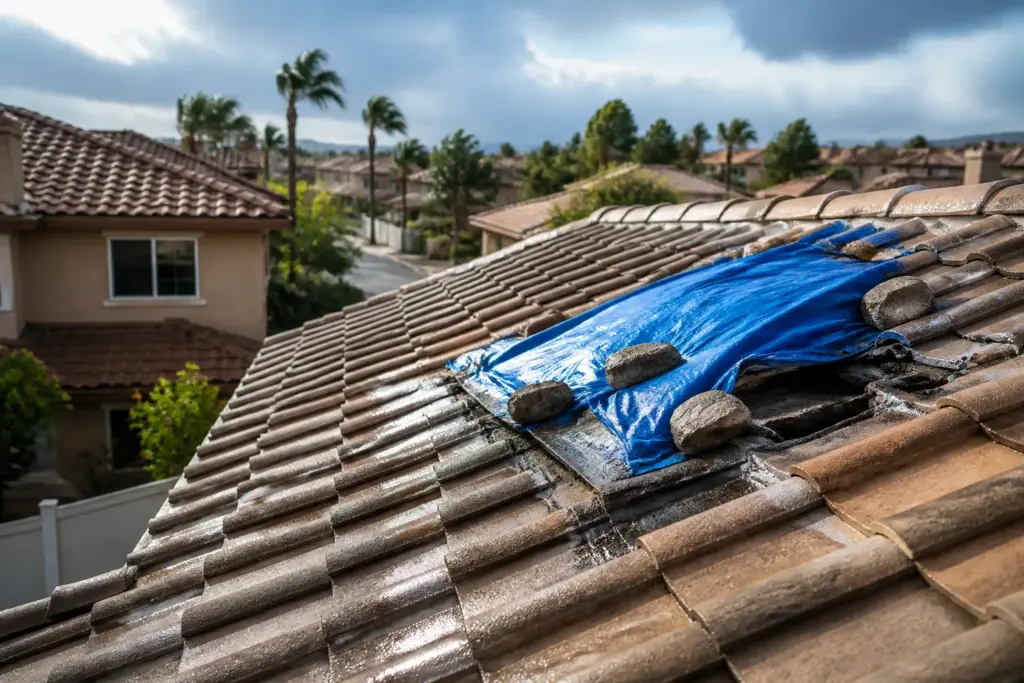
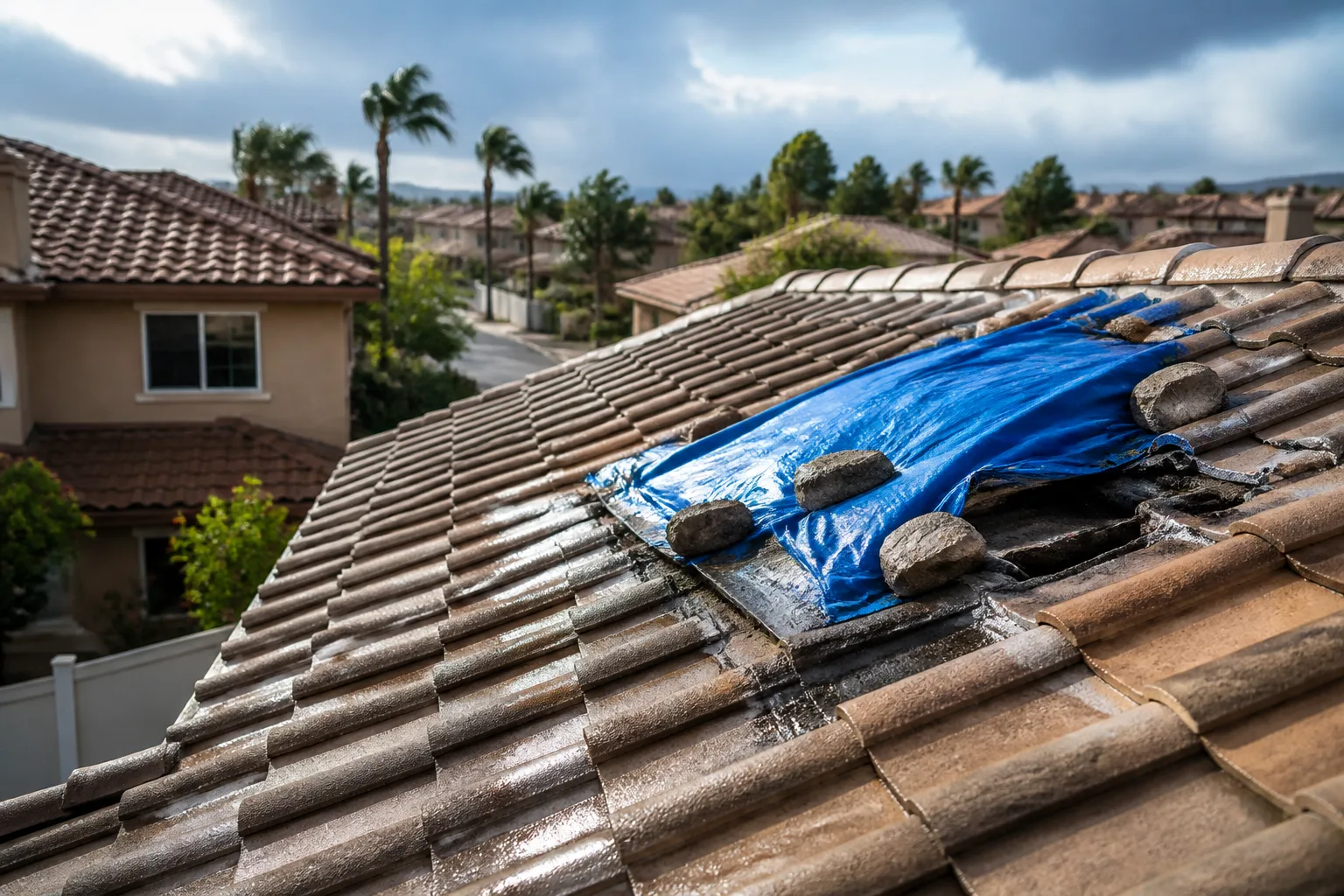
Santa Ana winds in Irvine routinely hit 30 to 40 mph with gusts higher. A tarp that’s not anchored properly becomes a sail. We’ve repaired roof damage that was caused by a poorly secured tarp flapping and tearing shingles off the same roof it was meant to protect.
How to Tarp a Breached Roof Without Creating a Secondary Hazard
- Never tarp in the rain or high wind. If conditions are still active, wait. The interior is already protected with buckets and plastic.
- Extend the tarp at least 3 feet past the damaged area on all sides. Water travels horizontally under shingles. A tarp that just covers the visible hole leaks at the edges.
- Tuck the tarp under the ridge cap or at least one course of shingles at the top edge. If you lay it flat over the damage and staple the edges, wind-driven rain slides underneath.
- Anchor with cap nails and furring strips, not rope tied to gutters. Gutters are not structural anchor points. A wind gust will pull the gutter off the fascia.
- Drive anchors into solid decking, not soft or rotted wood. If the decking is compromised, the nail has nothing to hold.
- Check the tarp again after the first Santa Ana event. Wind loosens everything.
If you’re not comfortable on a ladder, don’t get on one. A fall off a two-story Irvine home costs more than the roof repair. Call a professional. That’s a legitimate use of emergency service.
Emergency Patch vs. Emergency Repair: Know the Difference
An emergency patch stops water from entering tonight. That’s its only job. It’s a tarp, a tube of roofing cement, a piece of flashing screwed over a hole. It’s not code-compliant, it’s not warranty-eligible, and it’s not permanent. A homeowner who gets a patch and calls the job done has bought time, not a fix.
An emergency repair is a permanent, code-compliant fix completed under time pressure. It’s the damaged shingles replaced, the flashing re-sealed, the underlayment repaired. It might be a smaller scope than a full replacement, but it meets the same installation standard as any other roof work we do.
Why does this distinction matter? Two reasons. First, insurance. Your policy covers the cost to return the roof to its pre-loss condition, not to slap tar over a hole. If you claim a patch as a repair and sell the house later, a buyer’s inspector will flag it and you’ll pay to do the job twice. Second, warranties. Manufacturer material warranties from brands like GAF and CertainTeed don’t cover sections that were patched with off-brand materials and never properly integrated into the roof system.
At Gable Roof Repair, we’re repair-first by design. Our name reflects how we approach every call: we inspect, we diagnose, and we recommend a patch only when a patch is the right call. If the roof needs decking replaced, we’ll tell you. If three shingles will do it, we’ll tell you that too. Inspection first, recommendation second.
Vetting an Emergency Contractor in Irvine: The Five-Minute Filter
Storm-chasing crews show up in Irvine after every significant weather event. They knock on doors in Northwood and Woodbury, hand out flyers, and promise immediate service. Some are legitimate. Many are not. Here’s the filter that takes five minutes and eliminates the worst actors.
- Ask for the California contractor license number. Roofing work in California requires a C-39 roofing classification. Verify it on the Contractors State License Board website. If they hesitate, hang up.
- Ask for a certificate of insurance with you as the certificate holder. Their agent emails it to you. It shows general liability and workers’ compensation coverage. No workers’ comp means you could be liable if someone falls off your roof.
- Ask what brands they’re certified to install. A roofer who can only name one shingle brand is selling you that brand, not a solution for your roof. We work with seven manufacturers including GAF, CertainTeed, Owens Corning, and IKO because different roofs genuinely need different materials.
- Ask if they offer a standalone inspection as a separate service. A company that won’t diagnose without selling you a repair or replacement is filtering for revenue, not for your roof’s condition.
We’ve taken calls from Irvine homeowners who handed a $2,000 deposit to a crew with no license, no insurance, and no local address. The money was gone, and the roof was still leaking. The five-minute filter above would have caught it.
What Emergency Roof Repair Actually Costs in Irvine
Emergency roof repair pricing in Irvine varies by scope, but it’s useful to have a range in mind before you’re standing in water with your phone in hand.
| Scope of Emergency Work | Typical Irvine Price Range |
|---|---|
| Emergency tarp installation (materials and labor) | $350 – $700 |
| Small shingle repair (3 – 6 shingles, no decking damage) | $400 – $900 |
| Flashing repair around pipe boot or chimney | $500 – $1,200 |
| Underlayment repair with shingle replacement (10 – 15 shingles) | $1,000 – $2,500 |
| Decking section replacement with shingles | $1,800 – $4,000+ |
These numbers shift with material tier. A premium architectural shingle from Owens Corning or CertainTeed costs more per square than a builder-grade three-tab. Irvine’s exposure to sun and Santa Ana wind cycles means many roofs here fail at flashing transition points rather than at the shingles themselves. When we inspect an emergency leak, the most common culprits are pipe boots, valley flashing, and chimney counter-flashing, not the field shingles.
Every emergency repair we quote includes a written line-item scope. You’ll know exactly what you’re paying for before we start, and the price doesn’t change once work begins. No change orders on an emergency job. That’s not a sales tactic; it’s how we’d want to be treated if our own ceiling was dripping.
Why Irvine’s Climate Creates Specific Failure Patterns
Irvine doesn’t get the volume of rain that other Southern California coastal cities get, but when rain arrives, it often arrives with wind. Those are the conditions that expose marginal flashing and aging sealant. A roof that handles a light afternoon drizzle in Irvine completely fails during a wind-driven storm that pushes water sideways under shingles.
We also see a specific pattern in newer Irvine construction, particularly in communities built out in the last 15 to 20 years. Production builders used a lot of three-tab shingles and contractor-grade underlayment. Those materials hit the end of their functional life around year 15 to 18, which means large sections of Irvine’s housing stock are entering the replacement window at roughly the same time. A roof with manufacturer-rated granule loss that’s been quietly degrading for three years doesn’t fail on a Tuesday in July. It fails at 2 a.m. during the first real storm of the season.
Santa Ana winds compound everything. They dry out sealant faster than the manufacturer’s expected wear cycle, especially on south-facing and west-facing roof planes that get the worst of the afternoon sun plus the wind. If your home in Irvine has original pipe boots and the wind has been blowing dust and grit over your roof for ten years, that’s a ticking failure point. Our inspection service catches these before they become emergency calls. We offer roof inspection as a standalone service because diagnosis should not be bundled into a sales pitch.
The Bottom Line
When water comes through your Irvine ceiling, the sequence matters: protect the interior, document everything, stop the water, then call a professional who can tell you whether you need a patch or a permanent repair. The actions you take in the first 90 minutes directly affect your repair cost and whether your insurance claim survives contact with an adjuster.
If you’re in Irvine and need help, Gable Roof Repair offers free estimates. We’ll inspect the roof, tell you honestly whether you need a patch, a repair, or a replacement, and give you a written scope with fixed pricing. Call (866) 650-8319. If it’s not an emergency, we’re also the company that will tell you it’s not an emergency and save you the trip charge. Repair when it makes sense, replace when it’s right. That’s the whole job.
Frequently Asked Questions
Emergency roof repair in Irvine typically runs between $350 and $2,500 depending on scope. A tarp installation alone costs $350 to $700. A small shingle repair runs $400 to $900. Flashing repair sits between $500 and $1,200. If decking is damaged, expect $1,800 and up. Call (866) 650-8319 for an exact quote. Estimates are free.
Yes, if conditions are safe and you’re comfortable on a ladder. The tarp must extend at least 3 feet beyond the damage, tuck under a shingle course or ridge cap at the top, and anchor to solid decking with cap nails and furring strips. Never tarp during active rain or high wind. If you’re unsure, call a professional rather than risk a fall or a secondary wind damage claim.
Most Irvine homeowner policies cover sudden damage from storms, wind, and falling debris. They generally do not cover damage from deferred maintenance, so if the adjuster determines the leak came from a roof that was already failing, the claim may be denied or reduced. That’s why pre-repair documentation matters. Photograph everything before any work begins, and keep receipts from any emergency mitigation.
A properly installed tarp can hold for 30 to 90 days in Irvine conditions, but it’s a temporary solution. UV exposure degrades standard tarps within a few months, and Santa Ana winds will eventually loosen the anchors. Don’t wait. Schedule a professional inspection as soon as the weather stabilizes so you can move from patch to permanent repair on a timeline that protects your home. Call (866) 650-8319 to get that on the calendar.
Written by the team at Gable Roof Repair, serving Irvine since 2016.
Need Roofing Help?
Call Gable Roof Repair — licensed & insured, here with fast after-hours help in Irvine.
(866) 650-8319